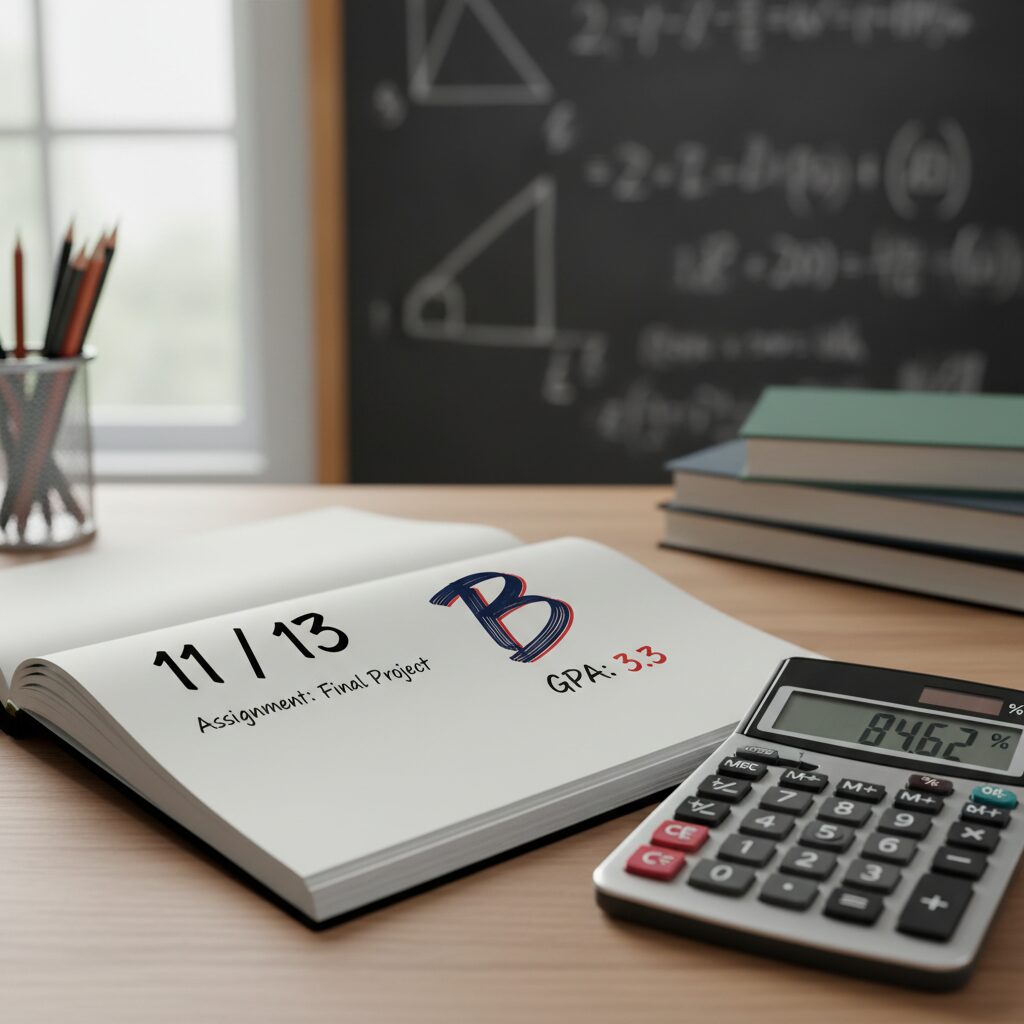
You’ve just received your latest test or assignment back, and the score at the top says 11/13. While you know you missed two points, the immediate question is usually: How does this actually impact my grade?
In the confusing world of weighted averages and varying grading scales, seeing a raw fraction doesn’t always tell the full story. Is it an A? A high B? Or did those two missed points drag you down further than expected?
The short answer is: 11 out of 13 is 84.62%.
On most standard US grading scales, this converts to a solid B. It indicates above-average performance, but there is nuance depending on your teacher’s specific grading policy.
How to Calculate the Percentage
If you want to double-check the math or understand how we got to that number, the formula is straightforward. You divide the number of points you earned by the total number of points available, and then multiply the result by 100.
The Math
- 11 ÷ 13 = 0.846153…
- 0.846153 x 100 = 84.615%
Most teachers and digital gradebooks round to two decimal places, giving you a final percentage of 84.62%.
What does this mean for your score?
- Points Earned: 11
- Points Missed: 2
- Percentage: ~85% (if rounded up)
What Letter Grade is 11 out of 13?
For the vast majority of high schools and colleges, 84.62% lands firmly in the B range. However, the specific “plus” or “minus” attached to that letter depends on the grading scale your institution uses.
Here is how 11/13 breaks down across different systems:
- Standard Scale: B (Typically 83%–86%)
- Plus/Minus Scale: B (Sometimes a B+ if the teacher rounds 84.6% up to 85%)
- Strict Scale: C+ (In highly competitive programs where an A is 94+, an 84 might slip into the high C range, though this is rare).
The “Rounding” Factor
This is a common question students ask: Will my 84.62% become an 85%?
If your teacher rounds to the nearest whole number, an 84.62% often rounds up to an 85%.
In many schools, an 85% is the cutoff for a B+. Check your syllabus if your teacher rounds up, your 11/13 is technically a B+. If they truncate (drop the decimals), it remains a solid B.
What is the GPA Value of 11/13?
Your Grade Point Average (GPA) is the cumulative average of your grades. Converting a single test score to GPA points helps you see how it impacts your semester standing.
- Letter Grade: B
- Standard GPA (4.0 Scale): 3.0
- Weighted GPA (Honors/AP): 3.5 – 4.0 (depending on school policy)
A 3.0 GPA is considered a “good” score. It meets the requirements for most college admissions and keeps you in good academic standing.
While it isn’t the 4.0 of an “A” student, a consistent string of 11/13 scores results in a respectable academic record.
Real-World Scenarios: How This Grade Affects You
Not all 11/13 scores are created equal. The impact of this grade depends heavily on what the assignment was. Here are three common scenarios to help you gauge the impact.
Scenario 1: The Pop Quiz (Low Weight)
If you scored 11/13 on a pop quiz that is worth 5% of your total grade, the impact is minimal.
- Verdict: Don’t stress. An 84% on a minor assignment is easily recoverable. One perfect homework assignment can balance this out.
Scenario 2: The Major Project (Rubric Based)
Sometimes, teachers use small numbers to represent big grades. A final essay might be graded out of 13 rubric points (e.g., 4 points for thesis, 4 for evidence, 5 for grammar).
- Verdict: High Impact. If this rubric represents a major test grade, that 84.62% is locked in as a significant portion of your semester average.
Scenario 3: Partial Credit
Did you get a question completely wrong, or did you lose points here and there?
- Verdict: Actionable. If you scored 11/13 because you missed one specific concept (a 2-point question), you know exactly what to study. If you lost 0.5 points on four different questions, it suggests a general lack of polish rather than a knowledge gap.
13-Point Grading Scale Reference Chart
To save you from doing the math next time, here is a breakdown of every possible score on a 13-point scale.
| Score | Percentage | Letter Grade (Standard) | GPA Estimate |
| 13 / 13 | 100% | A+ | 4.0+ |
| 12 / 13 | 92.31% | A- | 3.7 |
| 11 / 13 | 84.62% | B | 3.0 |
| 10 / 13 | 76.92% | C+ | 2.3 |
| 9 / 13 | 69.23% | D+ | 1.3 |
| 8 / 13 | 61.54% | D- | 0.7 |
| 7 / 13 | 53.85% | F | 0.0 |
Key Takeaway from the Chart
The gap between grades on small scales is massive. Missing just one more point (dropping to 10/13) moves you from a solid B to a C+.
This is why checking your work on short quizzes is vital, every single point represents nearly 8% of your grade.
Frequently Asked Questions
Is 11 out of 13 a failing grade?
Absolutely not. An 11 out of 13 is approximately 85%, which is well above the failing threshold (usually 59% or lower). It is a proficient, above-average score.
How can I raise this grade to an A?
To get an A (usually 90-93%+) on a 13-point assignment, you need a score of 12/13. A 12/13 calculates to 92.3%, which is a solid A- or A depending on the school. To get a high A, you typically need a perfect 13/13.
What if I got 11.5 out of 13?
If your teacher awards partial credit and gives you an extra half-point, your percentage jumps to 88.46%. In almost all schools, this rounds up to a B+, and in some lenient grading systems, it might even scrape the bottom of the A- range (usually 90%).
Conclusion
However, because the point scale is so small, consistency is key. Ensure you review the two points you missed so you don’t make similar mistakes on a final exam where the stakes are higher.
Need help pushing that B up to an A?
Don’t settle for “good enough.” Visit our study skills hub for free resources on test-taking strategies and note-taking methods that can help you capture those extra points next time.

Emily Carter is an academic writer with 7+ years of experience in education research, specializing in scholarships, admissions, and student calculators. She creates clear, reliable and helpful content to support students in making informed academic decisions.