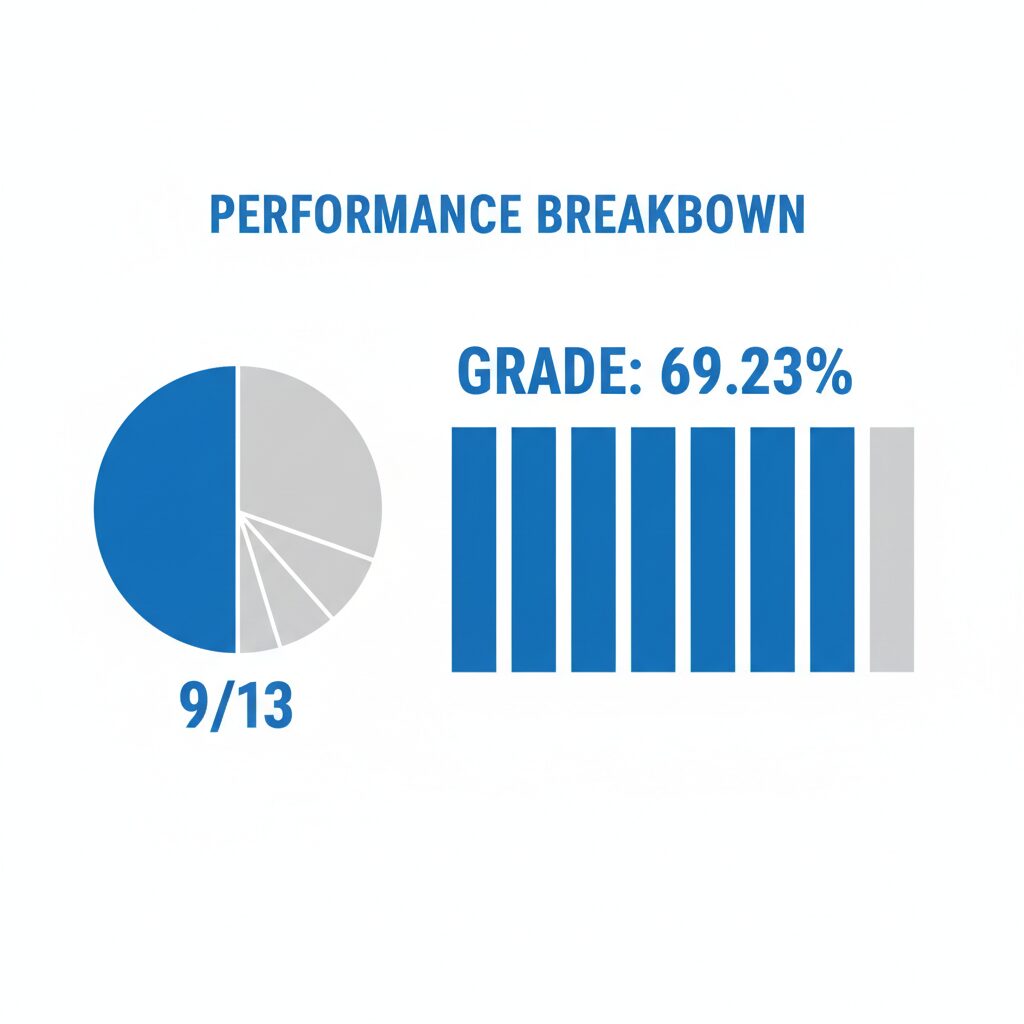
Staring at a test paper with “9/13” circled in red ink can be confusing. It looks like you got most of the questions right after all, 9 is a single-digit number away from 13.
But in the world of academic grading, calculating the exact percentage can sometimes deliver a harsh reality check.
The short answer: Getting 9 out of 13 correct results in a 69.23%.
In most US grading systems, this lands squarely in the D+ territory. It is technically a passing grade, but it sits right on the borderline of the C range.
However, a single number doesn’t tell the whole story. Grading scales differ between high schools and universities, and depending on your teacher’s rounding policy, that 69.23% could be pushed up to a 70% (C-).
How to Calculate Your Grade Percentage
You don’t need a fancy app to figure out your score. The formula for converting a fraction to a percentage is straightforward.
The Formula
$$(\text{Number of Correct Answers} \div \text{Total Number of Questions}) \times 100$$
The Math
- Divide your score (9) by the total possible points (13).
- $$9 \div 13 = 0.692307…$$
- Multiply that decimal by 100 to get the percentage.
- $$0.6923 \times 100 = 69.23%$$
Tip for rounding
Most teachers round to the nearest whole number. Since 69.23 is closer to 69 than 70, you are statistically more likely to keep the 69% than get the bump to 70%. However, if the score was 9.5/13 (73.07%), you would be safely in the C bracket.
What Letter Grade is 9 out of 13?
Determining your letter grade isn’t always black and white. It depends heavily on the specific grading scale your institution uses. Below are the three most common scenarios.
1. The Standard Scale (Most Common)
This is the system used by the vast majority of US high schools and colleges.
- Percentage: 69.23%
- Letter Grade: D+
- Definition: Below Average / Marginal Pass
2. The Whole Letter Scale (No +/-)
Some schools do not use plusses or minuses. In this system, the “D” range is usually huge (60-69%).
- Percentage: 69.23%
- Letter Grade: D
- Definition: Passing, but barely.
3. The Strict / Collegiate Scale
In competitive university courses or prerequisite classes (like Nursing or Engineering), a “C” (73%+) is often required to “pass” or continue to the next level.
In these strict environments, anything below a 70% might be considered failing.
- Percentage: 69.23%
- Letter Grade: F or No Credit
- Definition: Fail
Quick Reference Grading Chart (13 Questions)
If you are taking a class with frequent 13-point quizzes, keep this chart handy to see where you stand.
| Correct Answers | Wrong Answers | Percentage | Letter Grade (Standard) |
| 13 | 0 | 100% | A+ |
| 12 | 1 | 92.3% | A- |
| 11 | 2 | 84.6% | B |
| 10 | 3 | 76.9% | C+ |
| 9 | 4 | 69.2% | D+ |
| 8 | 5 | 61.5% | D- |
| 7 | 6 | 53.8% | F |
| 6 or less | 7+ | < 50% | F |
Is a D+ “Bad”? Understanding the Impact
Receiving a D+ can be discouraging, but it helps to understand exactly how it impacts your academic standing.
The GPA Impact
In a standard 4.0 GPA system, a D+ carries a weight of 1.3.
- A: 4.0
- B: 3.0
- C: 2.0
- D+: 1.3
If you are aiming for a 3.0 (B average) or higher, a 1.3 will significantly drag down your cumulative GPA. You will need to score an A (4.0) on a future assignment of equal weight to balance this grade out to a B- / C+ average.
The “Passing” Question
- High School: A 9/13 is usually a passing grade. You will earn credit for the assignment.
- College: If this is a General Education class, it usually passes. If this is a major-specific class, check your syllabus. Many departments require a C- (70%) or better to count the course toward your degree.
How to Calculate Grades Without a Calculator
If you aren’t allowed a phone in class and get your paper back with “9/13” written on it, you can estimate your grade using mental math.
Method 1: The “7 times 13” Trick
Memorize that $$13 \times 7 = 91$$. This means that $$9.1 \text{ out of } 13$$ is exactly 70%.
Since you scored 9, which is just slightly less than 9.1, you know immediately that you are just barely under 70%. This confirms you are in the high 60s (D+ range).
Method 2: The 10% Rule
- Find 10% of 13. That is 1.3.
- Take the total (13) and subtract 1.3 repeatedly to find the benchmarks.
- 13 – 1.3 = 11.7 (This is 90%)
- 11.7 – 1.3 = 10.4 (This is 80%)
- 10.4 – 1.3 = 9.1 (This is 70%)
- Since your score is 9, you are just below the 70% threshold.
How to Recover from a 9/13 Score
One D+ does not mean you will fail the class. However, because the sample size is small (only 13 questions), missing 4 questions has a heavy impact. Here is how to fix it.
1. Check the Weight
Is this a 13-point homework assignment or a 13-point pop quiz?
If it’s homework, and your homework category is only worth 10% of your grade, this score is negligible. If it is a quiz worth 30% of your grade, you need to strategize.
2. The “Next Test” Strategy
Let’s say you want to raise your average to a B (83%) over the span of two quizzes.
- Quiz 1: 9/13
- Quiz 2: ?/13
You need an average of roughly 83%. Total points available across two quizzes = 26.
$$26 \text{ points} \times 0.83 = 21.5 \text{ points needed total}.$$
You already have 9 points.
$$21.5 – 9 = 12.5.$$
The Goal: You need to score a 12.5/13 or perfect 13/13 on the next quiz to bring your average up to a solid B.
3. Ask for the “Round Up”
Because 69.23% is less than one percentage point away from a C- (70%), this is the perfect time to speak to your instructor.
- Do not ask for free points.
- Do ask to review the 4 questions you missed. Show that you are interested in learning the material.
- Sometimes, simply showing effort can encourage a teacher to round that 69.23% up to a 70% at the end of the semester.
Free Tools to Grade Your Papers
If you want to play around with “what-if” scenarios or calculate grades for other odd-numbered tests, try these free tools:
- Excel / Google Sheets: Type =9/13 into any cell to get the decimal. Click the “%” button in the menu bar to format it instantly.
- LMS (Canvas/Blackboard): Most Learning Management Systems have a “What-If” score function. Go to your grades page and type “13” into an upcoming assignment to see how it changes your overall course grade.
Summary
A 9 out of 13 converts to 69.23%, which is typically a D+.
While it isn’t an ideal score, it is usually a passing one. Because the total number of questions is so low, you can recover from this grade quickly by scoring high on your next assignment.
Review the questions you missed, verify the grading scale in your syllabus, and calculate exactly what you need on the next quiz to get back on track.

Emily Carter is an academic writer with 7+ years of experience in education research, specializing in scholarships, admissions, and student calculators. She creates clear, reliable and helpful content to support students in making informed academic decisions.