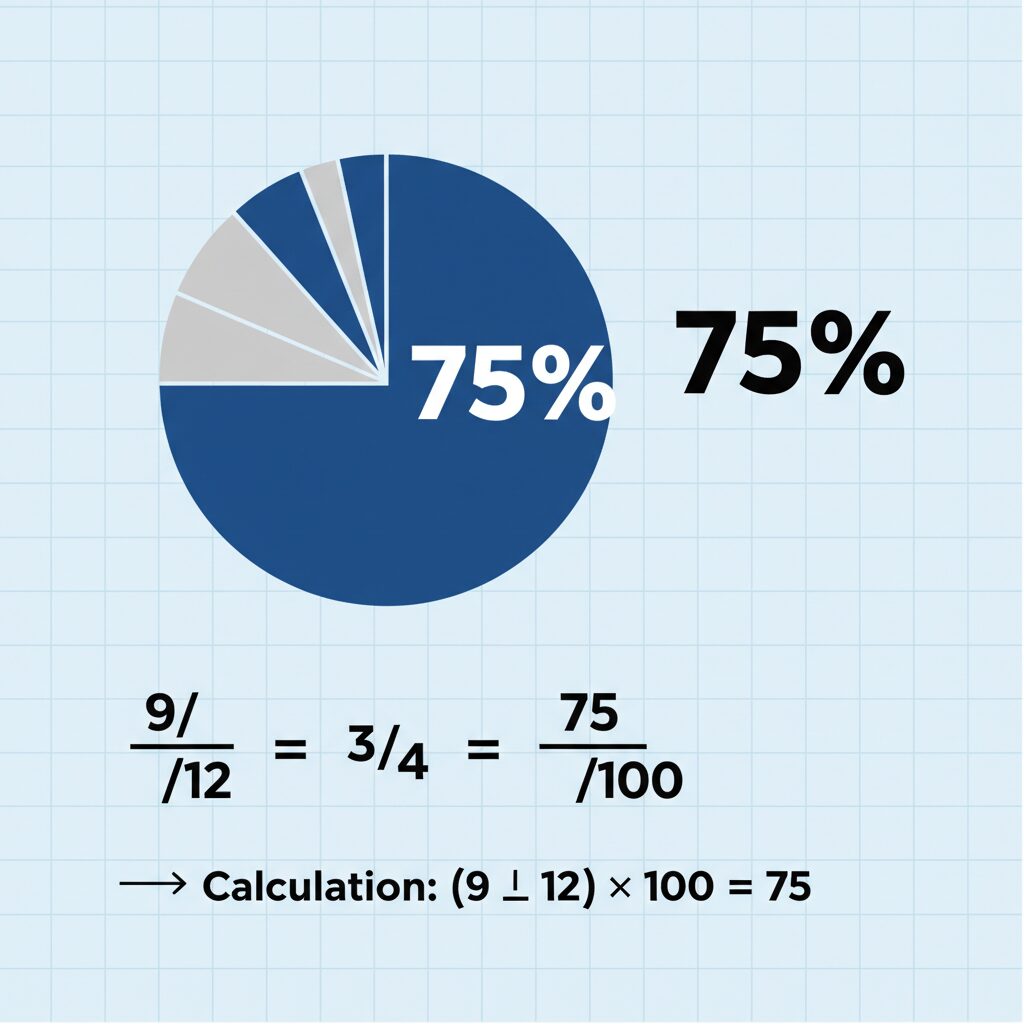
You just got your test back. You look at the top of the paper and see a score: 9/12.
At first glance, missing three points doesn’t seem too bad. But then the doubt creeps in. Is that an A? A B? Or did you just barely scrape by with a C?
In a world where every decimal point counts toward your GPA or your bottom line, knowing exactly where you stand is essential.
Here is the short answer: 9 out of 12 is 75%.
What Does 9 Out of 12 Mean?
Before diving into the math, it helps to visualize what the fraction 9/12 represents.
When you say “9 out of 12,” you are working with a fraction where:
- 9 is the Part (Numerator): This is what you achieved, scored, or have.
- 12 is the Whole (Denominator): This is the total amount possible.
In terms of percentages, “percent” literally means “per 100.” So, the goal is to figure out: if the test had 100 questions instead of 12, and you performed at the exact same rate, how many would you get right? The answer is 75.
How to Calculate 9 Out of 12 as a Percentage
While you can always punch numbers into a calculator, understanding the method helps you do this on the fly. Here are three ways to solve it, ranging from the standard method to a “pro tip” shortcut.
Method 1: The Calculator Method (Decimal Conversion)
This is the most reliable method for any fraction, even the messy ones.
- Divide the part by the whole: Take your numerator (9) and divide it by the denominator (12).
$$9 \div 12 = 0.75$$ - Multiply by 100: To turn a decimal into a percentage, you move the decimal point two places to the right.
$$0.75 \times 100 = 75%$$
Method 2: The Simplification Method (Mental Math)
This is the method most online calculators skip, but it is the fastest way to solve this specific problem in your head.
- Simplify the fraction: Look at 9/12. Both numbers are divisible by 3.
- $9 \div 3 = 3$
- $12 \div 3 = 4$
- So, 9/12 is the same as 3/4.
- Convert to percent: Most people intuitively know that “three quarters” equals 75 cents or 75%.
- Therefore, $3/4 = 75%$.
Method 3: The Proportion Method
If you prefer algebra, you can set it up as a proportion to solve for $X$.
$$\frac{9}{12} = \frac{X}{100}$$
- Cross-multiply: $12 \times X = 9 \times 100$
- Simplify: $12X = 900$
- Divide by 12: $X = 75$
Quick Conversion Table: Scores Out of 12
If you are grading a stack of papers or trying to predict your score if you miss a few questions, this table provides a quick reference.
| Score | Fraction | Percentage | Typical Grade |
| 12/12 | 1/1 | 100% | A+ |
| 11/12 | 11/12 | 91.6% | A- |
| 10/12 | 5/6 | 83.3% | B |
| 9/12 | 3/4 | 75% | C |
| 8/12 | 2/3 | 66.6% | D |
| 7/12 | 7/12 | 58.3% | F |
| 6/12 | 1/2 | 50% | F |
Is 75% a Good Score?
Now that we know 9 out of 12 is 75%, the next logical question is: Is that good?
The answer depends entirely on the context and the grading scale used by your institution. However, we can make some general assessments based on standard US grading policies.
The Academic Implications
In most high schools and colleges, 75% falls squarely into the C range (73%–76%).
- The Good News: It is a passing grade. You have demonstrated that you understand the majority (three-quarters) of the material. You likely won’t have to retake the class or assignment.
- The Bad News: It is considered “average” or “satisfactory.” If you are aiming for a high GPA or competitive class ranking, a 75% will lower your average if you typically score As and Bs.
How Much Did You Miss?
When the numbers are small, like 12, every mistake carries a heavy weight.
- Missing 1 point drops you to 91.6% (Still an A).
- Missing 2 points drops you to 83.3% (A solid B).
- Missing 3 points drops you to 75% (A mid C).
Because the total number of questions is low, each error costs you roughly 8.3% of your grade.
This is why a 9/12 can feel disappointing, you only got three things wrong, but your grade dropped by two whole letter bands.
Real-World Examples Beyond the Classroom
Understanding that 9 out of 12 is 75% is useful for more than just report cards. Here is how this percentage applies to daily life scenarios.
1. Time Management and Goal Setting
There are 12 months in a year. If you have stuck to your New Year’s resolutions for 9 months (January through September), you have successfully completed 75% of your year.
This is a great metric for quarterly business reviews or personal audits. If you hit October and haven’t started a goal, you only have 25% of the year left to make it happen.
2. Retail Discounts
Imagine you are buying a dozen (12) donuts, but the shop has a special where you only pay for 9 of them. This is effectively a “Buy 9, Get 3 Free” deal.
- You are paying 75% of the total price.
- You are receiving a 25% discount.
3. Battery Life and Capacity
Many visual indicators on devices break battery life into bars. If a battery icon is divided into 12 segments and 9 are lit up, you have 75% charge remaining.
This helps you estimate how much longer your device will last compared to a confusing number like “117 minutes remaining.”
4. Team Attendance
If you manage a team of 12 people and 9 show up for a meeting, your attendance rate is 75%. In project management, if a team member has completed 9 out of 12 assigned tasks, they are three-quarters of the way to the finish line.
Common Calculation Mistakes to Avoid
Math can be tricky when you are rushing. Here are two common errors people make when calculating this specific fraction.
Reversing the Division
A frequent mistake is dividing the larger number by the smaller number ($12 \div 9$).
- Incorrect: $12 \div 9 = 1.33$ (or 133%).
- Correction: Always divide the part (9) by the whole (12). Unless there were bonus points allowing you to score higher than the maximum, your percentage should generally be under 100%.
Ignoring Weighted Grades
If you scored 9/12 on a quiz, you might assume that quiz counts for 75% of your final grade. This is rarely true.
- Scenario: If quizzes are only worth 10% of your total class grade, getting a C on one small quiz won’t ruin your semester.
- Takeaway: Always check the weight of the assignment in your syllabus before panicking about 75%.
Improve Your Grade: Next Steps
If you are staring at a 9/12 and wishing it were higher, don’t worry. Since 75% is a C, it is a recoverable grade. Here is how to bounce back:
Review the 3 Missed Questions
Since the sample size is small, understanding exactly which 25% of the material you missed is crucial for the final exam.
Calculate the Impact
Use a weighted grade calculator to see how this 75% affects your overall average.
Aim for the “B” Next Time
To raise a 75% average to an 80% (B-), you would need to score an 85% on a subsequent assignment of equal weight.
Final Thoughts
The calculation is straightforward: 9 out of 12 is 75%.
Whether you are tracking grades, sales, or time, percentages allow you to standardize your progress and make smarter decisions.
