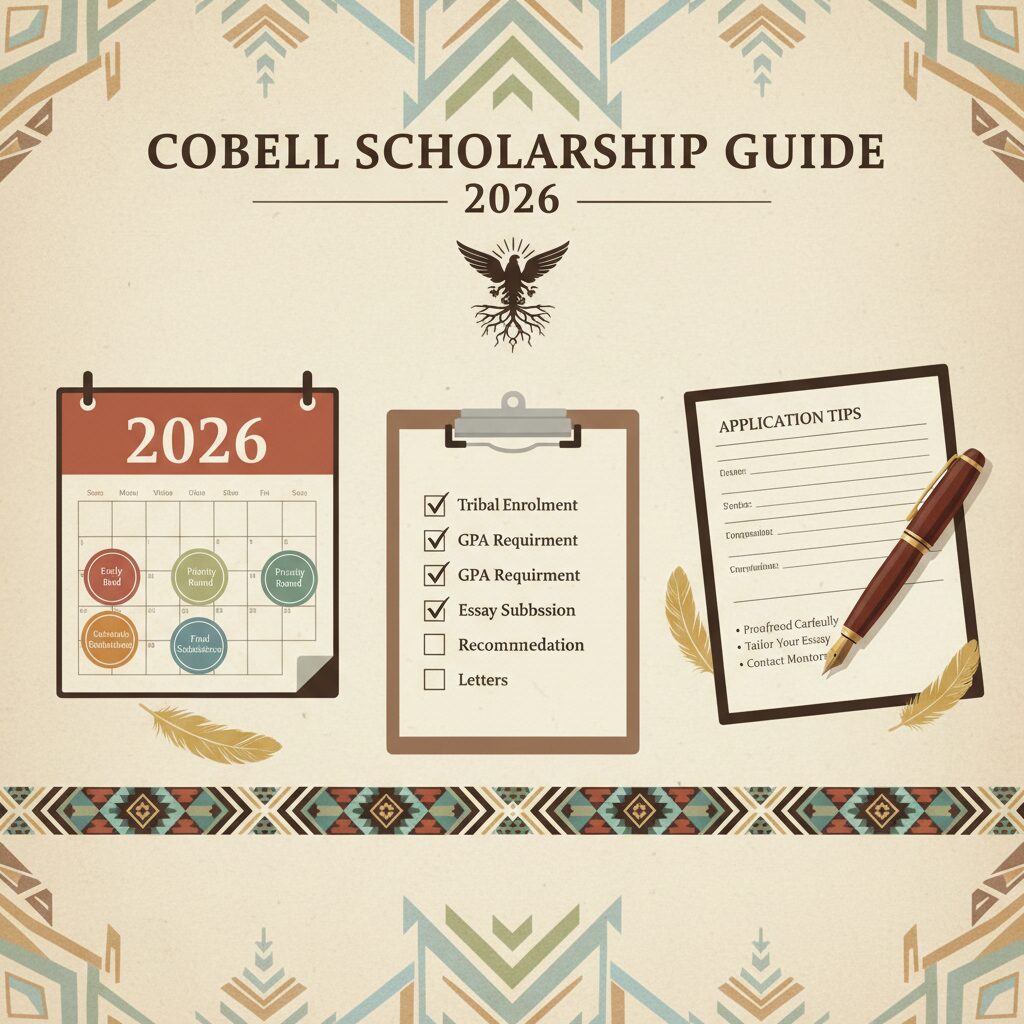
Securing funding for higher education is a major hurdle for many students, but for enrolled members of U.S. Federally Recognized Tribes, the Cobell Scholarship represents a transformative opportunity.
Established to honor the legacy of Elouise “Yellow Bird Woman” Cobell, this scholarship is more than just financial aid; it is an investment in Indigenous leadership and academic excellence.
Cobell Scholarship Summary
The Cobell Scholarship is administered by Indigenous Education, Inc. (IEI). It is a merit-based award, meaning applicants are selected based on academic achievement, leadership, and essay quality.
However, the actual disbursement of funds is determined by financial need (unmet need) as calculated by your university’s financial aid office.
It is important to note that this scholarship is non-renewable. Applicants must re-apply every single year to be considered for funding.
Scholarship Coverage and Award Amounts
The award amounts vary depending on the degree level and the applicant’s status (new vs. returning).
Based on the most recent academic year data, here is what selected finalists can expect:
- Undergraduate (New): Up to $5,000 per year
- Undergraduate (Returning): Up to $8,000 per year
- Graduate & Professional: Up to $12,500 per year
- Vocational: Up to $7,500 per year
- Summer Sessions: Variable funding available for those graduating or in cohort programs.
Note: These are maximum caps. The actual amount you receive cannot exceed your “Unmet Need” as determined by the Free Application for Federal Student Aid (FAFSA) and your institution.
Eligibility and Selection Process
Unlike many general scholarships, the Cobell Scholarship has strict citizenship and institutional requirements.
A common misconception is that descendants of tribal members are eligible; however, IEI explicitly states that only enrolled members are currently funded.
Here is a breakdown of the specific eligibility criteria:
| Criteria | Requirement Details |
| Tribal Citizenship | Must be an enrolled member of a U.S. Federally-Recognized Tribe or Alaska Native Corporation. (Descendants are not currently funded). |
| Institution Type | Must attend a non-profit, public or private institution. (For-profit universities are not eligible). |
| Enrollment Status | Must be enrolled full-time and degree-seeking. |
| GPA Requirement | No strict minimum GPA to apply, but to be competitive, IEI recommends: • 3.25+ for Undergraduate • 3.5+ for Graduate/Professional • 2.0+ for Vocational |
| Degree Level | Open to Vocational, Associate, Bachelor’s, Master’s, Doctoral, and Professional degrees. |
2026 Application Timeline
Missing a deadline is the primary reason eligible students are disqualified.
The Cobell Scholarship has different timelines depending on whether you are applying for the Academic Year (Fall/Spring), Summer, or Vocational training.
Please note the separate deadline for references. If your recommender does not submit by the April date, your application will be incomplete.
| Scholarship Opportunity | Application Opens | Application Closes | Reference Due Date |
| 2026-2027 Academic Year (Undergrad & Graduate) | December 15, 2025 | March 31, 2026 | April 7, 2026 |
| Summer 2026 Scholarship | February 15, 2026 | May 4, 2026 | N/A (No reference needed) |
| Vocational Scholarship | Open Year-Round | Rolling Basis | Until funds are exhausted |
| Graduate Summer Research Fellowship | September 1, 2025 | January 10, 2026 | January 10, 2026 |
How to Apply for the Cobell Scholarship
The application process is handled entirely through the OASIS (Online Application and Scholarship Information System) portal.
Follow these steps to ensure your application is submitted correctly.
Step 1: Create Your Profile
Visit the Cobell Scholar website and navigate to the OASIS portal. Create a user profile. This step collects your demographic information.
Tip: Use a personal email address (like Gmail) rather than a high school or college email that might expire.
Step 2: Complete the Eligibility Form
Once logged in, you must complete the “Eligibility Form.” This is a crucial step that acts as a filter.
Based on your answers (degree level, tribe, school), the system will match you with the correct scholarship application.
Step 3: Submit the Specific Application
After matching, the specific application (e.g., “Undergraduate Scholarship”) will appear under “Scholarships & Applications.”
- Essays: You will need to answer prompt questions regarding your leadership, community involvement, and academic goals.
- Reference: Enter the name and email of your recommender. The system will email them a link. You must ensure they complete this by April 7, 2026.
Step 4: Verification (For Finalists Only)
If you are selected as a finalist (usually notified in May), you will be required to upload documents such as:
- Official proof of Tribal Enrollment.
- Transcripts.
- Verification of enrollment at your university.
Frequently Asked Questions
Can I apply if I am a descendant but not an enrolled member?
No. Currently, the Cobell Scholarship is only available to enrolled members of U.S. Federally-Recognized Tribes or Alaska Native Corporations.
Is the scholarship renewable?
No. The Cobell Scholarship is non-renewable. You must submit a new application and updated essays every academic year to be considered for funding.
Can I use this scholarship at a for-profit trade school?
No. The institution must be a non-profit (public or private) regionally accredited institution.
What happens if I miss the March 31 deadline?
Late applications are generally not accepted. However, if you miss the Academic Year deadline, you may check if the Vocational application applies to your program, as it remains open year-round until funds are exhausted.
When will I know if I received the scholarship?
Finalist offers are typically sent out beginning May 1st. You should check your email and the OASIS portal regularly during this time.
Final Thoughts
By adhering to the 2026 timeline, ensuring your reference is submitted by April 7, and writing authentic essays that showcase your leadership, you maximize your chances of success.
Don’t wait until the last week of March to begin. Visit the official Cobell Scholarship website today to access the OASIS portal and start your profile.
