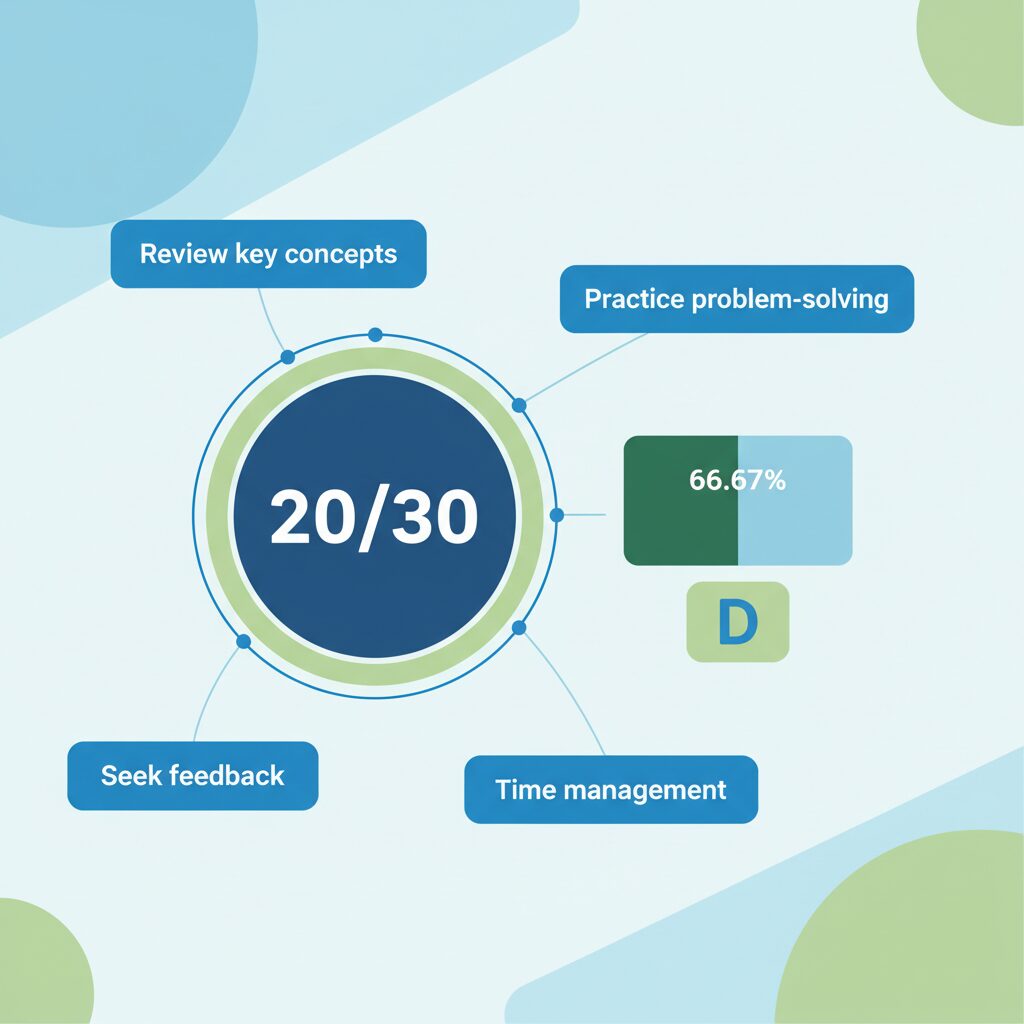
Getting your test back and seeing “20/30” circled in red ink can be confusing. It’s not a perfect score, but it doesn’t look like a total failure either. You’re likely asking yourself: Is this a passing grade?
Will it ruin my GPA? And most importantly, how close was I to a B or a C?
Regardless of how you feel about the score, the first step is translating that fraction into a language everyone understands: percentages and letter grades.
Knowing exactly where you stand is the only way to improve for the next exam.
How to Calculate 20 out of 30 as a Percentage
Before we look at letter grades, we need the raw percentage. This number is the universal standard in academics, allowing you to compare a 30-question quiz to a 100-point final exam.
The math is simple. To find the percentage, you divide your score (the part) by the total possible points (the whole) and then multiply the result by 100.
The Formula
(Score ÷ Total Questions) x 100 = Percentage
The Calculation
- Divide 20 by 30: 0.6666…
- Multiply 0.6666 by 100: 66.67%
So, a score of 20 out of 30 is approximately 66.67%.
What does “Missing 10” really mean?
Getting 20 correct means you missed 10 points. On a test with only 30 questions, every single question carries significant weight. Specifically, each question is worth 3.33% of your total grade.
- 1 Question Wrong: 96.6% (A)
- 5 Questions Wrong: 83.3% (B)
- 8 Questions Wrong: 73.3% (C)
- 10 Questions Wrong: 66.6% (D)
When you realize that missing just three questions drops you a full letter grade, it becomes easier to see how a few small mistakes can drag a score down to 66%.
What Letter Grade is 20 out of 30?
In most standard grading systems in the United States, a 66.67% is considered a D.
However, because 66.67% is so close to the next tier, it sits right on the borderline. Depending on your teacher’s grading policy, this could be rounded up.
- Strict Scale: 66.67% is a D.
- Rounding Policy: If your teacher rounds 0.5 and above up to the nearest whole number, your score becomes a 67%, which is often a D+.
Standard 30-Point Grade Scale
Here is how a 30-point assignment typically breaks down. Keep in mind that grading scales can vary by school district or university, so always check your syllabus.
| Score | Percentage | Letter Grade | Performance Level |
| 29–30 | 97%–100% | A+ | Outstanding |
| 28 | 93% | A | Excellent |
| 27 | 90% | A- | Excellent |
| 26 | 86.6% | B | Above Average |
| 25 | 83.3% | B | Above Average |
| 24 | 80% | B- | Above Average |
| 22–23 | 73%–76% | C | Average |
| 21 | 70% | C- | Average |
| 20 | 66.67% | D | Below Average |
| 18–19 | 60%–63% | D- | Poor |
| 0–17 | 0%–59% | F | Failure |
Is a Score of 20/30 Considered Good?
A score of 20 out of 30, or 66.67%, is generally considered below average in most academic settings.
Passing Criteria
While a 20/30 earns you a passing grade, since most schools set the failure threshold at 59% (17/30), it just barely clears that bar.
You are 3 points above failing, which means you met the minimum requirements but didn’t demonstrate strong mastery of the material.
Impact on GPA
A “D” grade typically converts to a 1.0 GPA. If your school uses plus grades, a D+ becomes a 1.3 GPA. Earning a D can pull down your overall GPA, especially if you usually score As or Bs in other classes.
Prerequisite Requirements
If the course in which you earned a 20/30 is a prerequisite for more advanced classes, keep in mind that many schools require at least a “C” to move on. A D may mean you need to retake the exam or the entire class before progressing.
In the academic world, a “D” usually means you have met the bare minimum requirements to pass, but you haven’t demonstrated a strong grasp of the material.
For Passing
Yes, you passed. Most schools set the failure line at 59% (which would be a score of 17/30). You are safely 3 points above failing.
For GPA
A “D” grade converts to a 1.0 GPA. If you receive a D+, it converts to a 1.3 GPA. This will likely lower your cumulative GPA if you typically earn As or Bs.
For Prerequisites
If this class is a prerequisite for a higher-level course (like taking Algebra I before Algebra II), many schools require a “C” or better to advance. A 20/30 might require you to retake the exam or the course to move forward.
How to Raise Your Grade Next Time
The gap between a D and a C on a 30-question test is smaller than you think. You don’t need to study 10 extra hours; you just need to save a few points.
The Math of Improvement
You are currently at 20 (66.6%). Let’s look at what you need to hit the next major milestones:
- Target: C (73%)
- Required Score: 22 out of 30
- Difference: 2 questions
- Target: B (83%)
- Required Score: 25 out of 30
- Difference: 5 questions
You are only two correct answers away from a solid “average” grade. Here is how to find those two points on your next test.
1. Identify the “High Cost” Errors
Since every question is worth 3.33%, you can’t afford “silly” mistakes. Review your graded paper and categorize your 10 incorrect answers:
- Misread Questions: Did you answer “false” when it asked for “true”?
- Skipped Steps: Did you know the answer but rush the process?
- Blank Answers: Did you run out of time?
If even two of your errors were because you rushed, slowing down could immediately bump you up a letter grade next time.
2. Focus on Partial Credit
On a 30-point test, teachers often give partial points for showing your work, especially in math or science.
If you see a big “X” on a question where you got the right process but the wrong final number, politely ask your teacher to review it.
Gaining just one point back would move you from a 66.6% to a 70% (C-).
3. Change Your Study Strategy
A score of 66% implies you understand about two-thirds of the material. You aren’t “lost,” but you have gaps.
- Don’t memorize, apply: Instead of reading definitions, try to teach the concept to an empty room (or a pet). If you can explain it out loud, you know it.
- Simulate the test: If you know the test will be 30 questions in 45 minutes, practice answering questions under a timer to get used to the pressure.
Frequently Asked Questions
Does a 20/30 round up to a C?
Usually, no. A 20/30 is 66.67%. Even if a teacher rounds up to 67%, that is typically a D+. To get a C- (70%), you generally need a raw score of 21.
Is 20 out of 30 a failing grade?
In most US schools, no. Failing is typically anything below 60%. Since you scored 66.67%, you have passed the test, though it is on the lower end of the passing spectrum.
What is the GPA for a 20/30?
On a standard 4.0 scale, a D is a 1.0. If your school counts a 67% as a D+, it is a 1.3.
Final Thoughts
Remember the 3.33% rule. On a short test like this, accuracy is everything. Recovering just two or three points on the next assignment will rocket your grade out of the D range and into the C or B range.
Review your mistakes, check for partial credit opportunities, and go into the next exam with a strategy.
