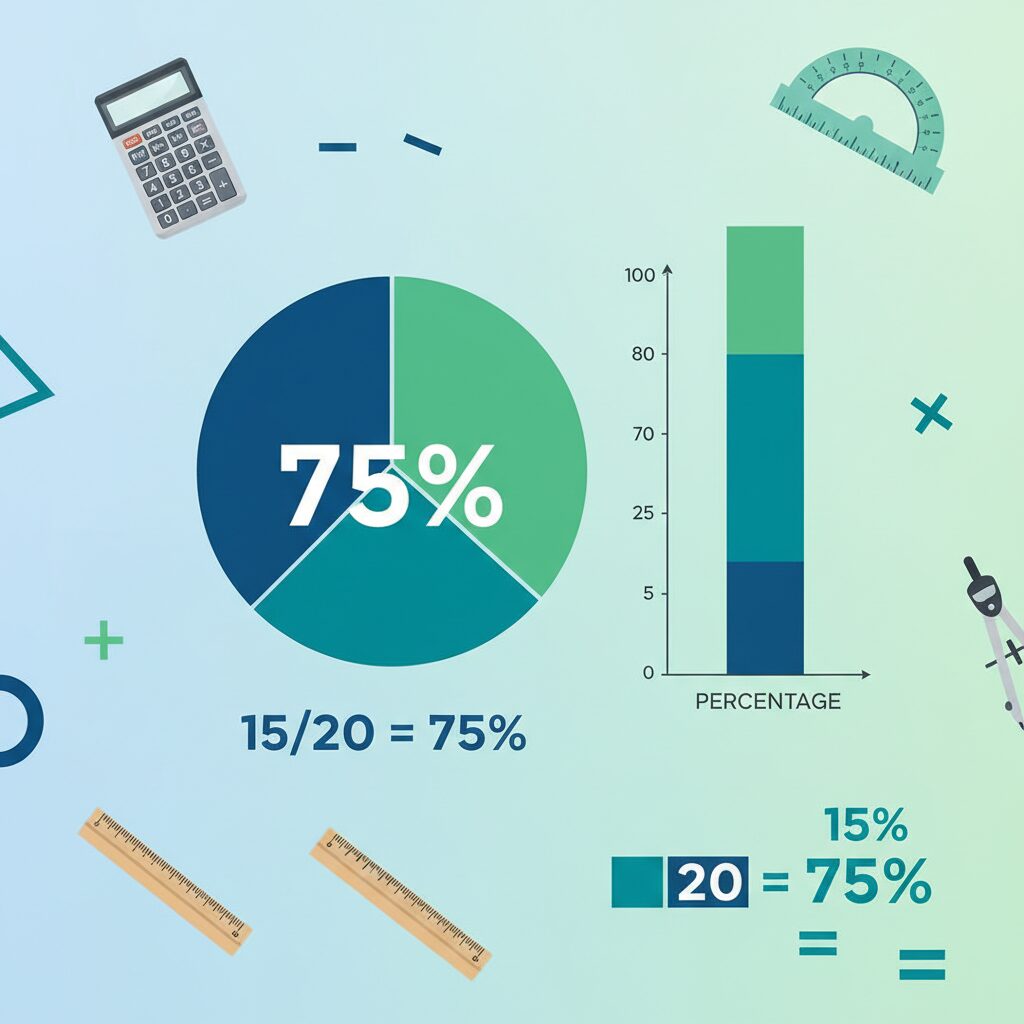
Receiving a grade of 15 out of 20 can evoke a mixed bag of emotions. Is it a solid pass? Is it average? Or, depending on where you are in the world, is it actually exceptional?
In the world of academics, raw scores often need translation to be fully understood.
While seeing “15/20” on a paper might give you a rough idea of your performance, converting that fraction into a percentage and a letter grade provides the context needed to track your GPA and academic progress accurately.
How to Calculate 15 out of 20 as a Percentage
Before analyzing the “quality” of the grade, let’s establish the math behind it.
Converting a raw score into a percentage is a straightforward process, but understanding the formula helps you apply it to any test score in the future.
The Basic Formula
To find the percentage, you divide the number of points earned (the part) by the total number of points possible (the whole), and then multiply the result by 100.
Formula: (Part ÷ Whole) × 100 = Percentage
Calculation:
- Divide 15 by 20: 15 ÷ 20 = 0.75
- Multiply by 100: 0.75 × 100 = 75%
So, a score of 15 out of 20 is exactly 75%.
The Mental Math Trick
If you don’t have a calculator handy, there is an easier way to figure this out. Since 20 goes into 100 exactly five times, you can simply multiply your score by 5 to get the percentage.
- Score: 15
- Multiplier: 5
- Calculation: 15 × 5 = 75
This method works for any score out of 20. If you got a 12/20, just think 12 × 5 = 60%.
What Letter Grade is 15 out of 20?
In the United States, a 75% is most commonly associated with the letter grade C. However, grading scales can differ wildly between universities, high schools, and specific academic departments.
Here is how 15/20 typically translates across different grading systems:
Standard Grading Scale
This is the most common scale used in US high schools and colleges.
| Raw Score | Percentage | Letter Grade | Definition |
| 19-20 | 95-100% | A | Excellent |
| 17-18 | 85-90% | B | Good |
| 15 | 75% | C | Satisfactory |
| 13-14 | 65-70% | D | Below Average |
| 0-12 | 0-60% | F | Failure |
International Context: When 15/20 is an “A”
It is important to note a significant gap in how grades are perceived globally.
If you are studying in a system that uses a 20-point scale (common in France and some Baccalaureate programs), a 15/20 is widely considered a very good to excellent score, often equivalent to an A or a high B+ in the US system.
In France, for example, the grading is much harsher. A 10/20 is passing, a 12/20 is “Good,” and a 15/20 is “Bien” (Very Good), a score that is quite difficult to achieve.
Always check your specific institution’s handbook to confirm which scale applies to you.
What is the GPA Equivalent of a 15/20?
Your Grade Point Average (GPA) is the cumulative average of your letter grades. Understanding how a single assignment or exam impacts this average is vital for maintaining your academic standing.
Based on the standard US 4.0 scale:
- Percentage: 75%
- Letter Grade: C
- GPA Points: 2.0
If your school uses “Plus/Minus” grading, a 75% might fall into the C+ category (typically 77-79%) or remain a C (73-76%).
- C (73-76%): 2.0 GPA
- C+ (77-79%): 2.3 GPA
- C- (70-72%): 1.7 GPA
A 2.0 GPA is widely considered the baseline for “Satisfactory” performance. It is often the minimum requirement to graduate from high school or to avoid academic probation in college.
Is 15 out of 20 a Good Grade?
“Good” is subjective, but statistically speaking, a 15/20 (75%) is average.
It indicates that you have grasped the majority of the material (three-quarters of it, to be precise) but have significant gaps in your understanding. You missed 25% of the content, which equates to 5 missed points on a 20-point scale.
The Positive View
- You Passed: You are well above the failure line (usually 60% or 12/20).
- Foundation is There: You understand enough to move forward, though you may struggle with advanced concepts built on this material.
The Critical View
- Room for Improvement: A 75% sits squarely in the “middle of the pack.” For competitive university admissions or honors programs, this grade may lower your overall standing.
- GPA Impact: A 2.0 GPA can drag down higher grades. For example, if you have an A (4.0) in one class and a C (2.0) in this one, your average drops to a B (3.0).
How Can You Improve Your Score?
If you are unsatisfied with a 15/20, the good news is that on a 20-point scale, small improvements yield massive percentage gains.
Because the total number of points is low, every single point you earn back is worth 5 percentage points.
Here is the math on how to jump to the next letter grade:
Target: B Grade (80-89%)
To reach a B (or B-), you generally need an 80%.
- Current Score: 15/20 (75%)
- Goal: 16/20
- Math: 16 × 5 = 80%
- Gap: You only need 1 extra point to move from a C to a B-.
Target: A Grade (90-100%)
To reach an A range, you typically need a 90%.
- Goal: 18/20
- Math: 18 × 5 = 90%
- Gap: You need 3 extra points to move from a C to an A-.
Actionable Tips for Improvement
- Review the “Missed 5”: Since you missed 5 points, analyze them. Were they silly mistakes (misreading a question) or concept errors (not knowing the answer)?
- Focus on Weighted Assignments: If this 15/20 was a quiz, it might have less impact than a final exam. Prioritize studying for assignments with higher point values.
- Use the “5% Rule”: Remember that on this scale, every single mark is worth 5%. Fighting for partial credit on one question can literally change your letter grade.
Frequently Asked Questions
Is 15 out of 20 an F?
No. In almost all standard grading scales, an F is below 60% (12/20). A 15/20 is a 75%, which is a passing C grade.
What is 15 out of 20 as a decimal?
To get the decimal, simply divide 15 by 20. The answer is 0.75.
How much is 15.5 out of 20?
If you managed to scrape an extra half-point, your calculation is: 15.5 × 5 = 77.5%. This often rounds up to 78%, which is a solid C+ and very close to a B-.
Master Your Grades
Understanding that a 15 out of 20 is a 75% is just the first step. The real value comes from knowing that you are only a single point away from a B grade.
In academics, clarity is power. Now that you know exactly where you stand, you can strategize on how to find those few extra points that will transform your GPA.
