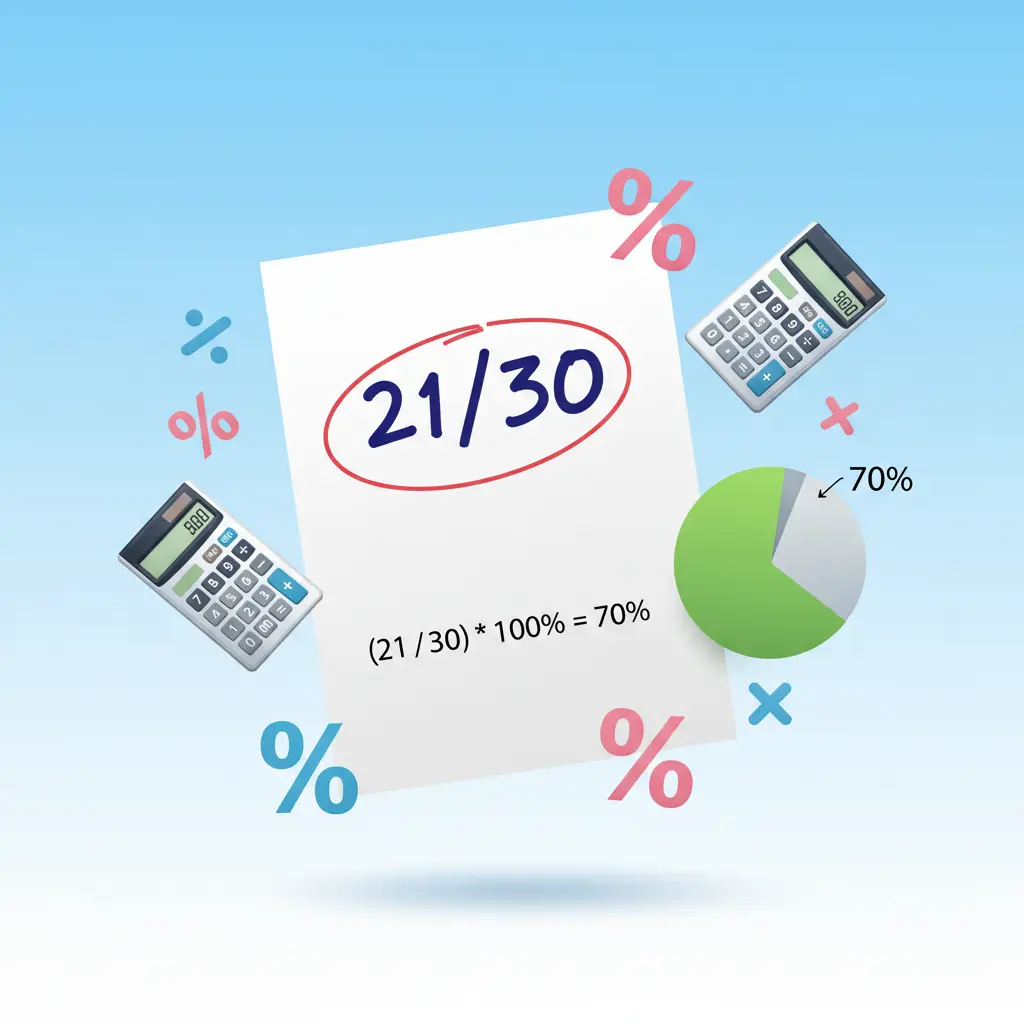
You flip over your test paper or check your online portal, and there it is: a score of 21 out of 30. The first thing that likely crosses your mind is, “Is this good?” followed quickly by, “Did I pass?” While raw scores give you the numbers, they don’t always give you the full picture of your performance.
Understanding how to convert your raw score into a percentage is an essential skill, not just for academics but for daily life.
Whether you are a student trying to calculate your GPA, a parent helping with homework, or just trying to figure out a discount at the store, knowing the math behind percentages is incredibly useful.
The Short Answer
If you are in a rush, here is the bottom line: 21 out of 30 is exactly 70%.
In most academic grading scales, a 70% corresponds to a C- letter grade. While this is considered a passing score in many institutions, it typically sits on the lower end of the average range.
The Math Behind the Number
To truly understand your score, it helps to know how we arrived at that 70%. The word “percent” literally means “per 100.” When we ask “what percentage is 21 out of 30,” we are essentially asking: “If the test had 100 questions instead of 30, how many would you have gotten right?”
Here is the step-by-step breakdown of the formula:
Percentage = (Part ÷ Whole) × 100
Step 1: Identify the Part and the Whole
In fractions, we have a numerator (the top number) and a denominator (the bottom number).
- The Part (Numerator): This is your score, or the number of questions you answered correctly. In this case, it is 21.
- The Whole (Denominator): This is the total number of questions or points available. In this case, it is 30.
Step 2: Divide the Part by the Whole
Next, you divide the number you got right by the total number.
- Calculation: 21 ÷ 30
- Result: 0.7
Step 3: Convert to a Percentage
Finally, to turn that decimal into a percentage, you multiply by 100. Moving the decimal point two places to the right achieves the same result.
- Calculation: 0.7 × 100
- Final Result: 70%
This method works for any test score. If you scored 15 out of 30, you would divide 15 by 30 to get 0.5, which is 50%.
Converting 21/30 to a Letter Grade
Now that you know your percentage is 70%, the next step is determining what that looks like on a report card.
Grading scales can vary by country, state, or even specific school districts, but most US-based institutions follow a standard 10-point scale.
Here is where a 21/30 falls on the standard grading chart:
| Letter Grade | Percentage Range |
| A | 90% – 100% |
| B | 80% – 89% |
| C- | 70% – 72% |
| D | 60% – 69% |
| F | 0% – 59% |
With a flat 70%, a score of 21 out of 30 is generally considered a C-.
What Does a C- Mean?
A C- is widely recognized as a “satisfactory” grade. It indicates that you have grasped the majority of the material, but there are significant gaps in your understanding.
- Is it passing? Yes, in most high schools and undergraduate courses, a C- is a passing grade that awards credit. However, some prerequisite college courses require a standard C (usually 73% or higher) to move on to the next level.
- Is it “good”? It is generally viewed as below average. While it isn’t a failure, it signals that you might struggle with more advanced concepts built on this material.
The Impact on Your GPA
If you are a high school or college student, you are likely concerned about your Grade Point Average (GPA). Your GPA is a calculated average of all your letter grades, usually on a scale of 0.0 to 4.0.
Because a 21/30 translates to a C-, it carries a specific weight for your GPA calculation.
- Standard Scale: A C- typically converts to a 1.7 GPA.
- Impact: If you are aiming for the Honor Roll or Dean’s List, a 1.7 will lower your overall average. However, if you are strictly trying to pass a difficult general education requirement, a 1.7 achieves that goal.
Analyzing Your Performance
Getting a 21 out of 30 means you answered 70% of the questions correctly and missed 30% of them.
To break it down further:
- Correct Answers: 21
- Incorrect Answers: 9
Missing 9 questions (or points) out of 30 might not feel like a lot, but because the total number of questions is low, each mistake carries more weight. On a test with 100 questions, missing 9 would give you a 91% (an A-). On a test with only 30 questions, missing 9 drops you down to a C-.
This is why short quizzes can be deceptively difficult; you have less room for error.
Real-World Applications
Understanding how to calculate “21 out of 30” isn’t just for the classroom. This specific percentage pops up in various real-life scenarios.
Shopping Discounts
Imagine you are shopping and see a shirt originally priced at $30. It is on sale for $21. To find out the discount, you need to know what percentage of the price you are paying.
- You are paying $21 out of $30.
- As we calculated, that is 70%.
- This means you are paying 70% of the original price, which equates to a 30% discount.
Sports Statistics
If a basketball player attempts 30 shots in a game and makes 21 of them, their shooting percentage is 70%. In the context of basketball, a 70% field goal percentage is exceptionally high and would be considered an elite performance.
This highlights how “good” a percentage is often depends on the context!
How to Improve Your Score
If you aren’t happy with a C-, the good news is that because the “Whole” (30) is a small number, improving your score by just a few points results in a massive jump in percentage.
Here is what happens if you get just a few more questions right next time:
- 22 out of 30: 73% (C) — You jumped from a C- to a C just by getting one more point.
- 24 out of 30: 80% (B-) — Getting three more right moves you an entire letter grade up.
- 27 out of 30: 90% (A-) — You only need to answer 6 more questions correctly to reach ‘A’ territory.
Frequently Asked Questions
Is 21 out of 30 a failing grade?
No, 21 out of 30 is not a failing grade. It converts to 70%, which is a C-. In most academic institutions, an F (fail) is considered anything below 60% or sometimes below 59%.
How many questions can I miss to still get an A?
To get an A (usually 90% or higher), you need a score of at least 27 out of 30. This means you can only miss 3 questions (or points).
- 27/30 = 90% (A-)
- 28/30 = 93% (A)
- 29/30 = 96% (A)
- 30/30 = 100% (A+)
What is 21 out of 30 as a fraction?
The fraction is 21/30. However, in math, we usually want to simplify fractions to their lowest terms. Both 21 and 30 are divisible by 3.
- 21 ÷ 3 = 7
- 30 ÷ 3 = 10
- So, the simplified fraction is 7/10.
Is a 70% good for a difficult class?
Context matters. In a standard high school class, a 70% is below average. However, in highly difficult college courses like Organic Chemistry or Advanced Calculus, grading curves are often applied.
If the class average was a 55%, then a raw score of 70% might actually be scaled up to a B or even an A. Always check your syllabus to see if your professor curves grades.
Moving Forward from a C-
Receiving a 21 out of 30 can be a relief (you passed!) or a frustration (you wanted a B). The most important takeaway is understanding the weight of the numbers. On a 30-point assignment, every single point is worth roughly 3.3%.
This implies that small mistakes add up quickly, but it also means that small improvements yield big results.
Use this calculation to set goals for your next assignment. Aiming for just 3 more correct answers can transform your grade from average to above average.
