Enter your marks (or totals) below. Percentages are calculated automatically. Click Calculate to view your final merit.
Getting into a top university like COMSATS University Islamabad (CUI) is a major goal for many students across Pakistan. With a reputation for excellence in science and technology, securing a spot at CUI is competitive.
The first step toward that goal is understanding how your academic performance translates into a merit score. This score is the key that unlocks the door to your desired program.
Understanding the COMSATS Merit Formula
COMSATS uses a specific formula to create a final merit score for undergraduate applicants. This ensures a standardized and fair evaluation process.
The formula combines your scores from your previous academic records and the university’s entry test.
The weightage for each component is as follows:
- Matriculation (SSC): 10%
- Intermediate (FSc/HSSC): 40%
- NTS Entry Test: 50%
The heavy emphasis on the NTS test score means that a strong performance in the entrance exam can significantly boost your chances, even if your previous academic scores aren’t perfect.
How to Calculate Your COMSATS Merit: Step-by-Step
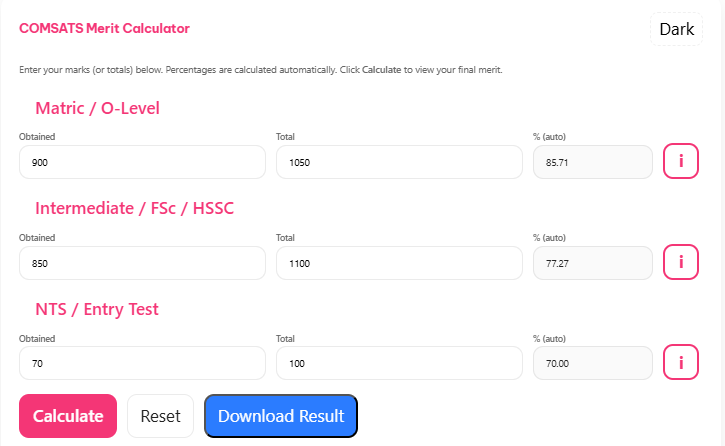
Now, let’s get into the specifics of the calculation. The formula to determine your aggregate merit percentage is:
Merit = (Matric Percentage × 0.10) + (FSc Percentage × 0.40) + (NTS Test Percentage × 0.50)
To use this formula, you first need to convert your marks for each component into a percentage.
Here’s how:
- Matric Percentage = (Your Obtained Matric Marks / Total Matric Marks) × 100
- FSc Percentage = (Your Obtained FSc Marks / Total FSc Marks) × 100
- NTS Percentage = (Your Obtained NTS Marks / Total NTS Marks) × 100
An Example Calculation
Let’s walk through an example to make it crystal clear. Imagine a student has the following scores:
- Matric Marks: 900 out of 1100
- FSc Marks: 1000 out of 1100
- NTS Score: 70 out of 100
Step 1: Calculate the percentage for each component.
- Matric Percentage: (900 / 1100) × 100 = 81.82%
- FSc Percentage: (1000 / 1100) × 100 = 90.91%
- NTS Percentage: (70 / 100) × 100 = 70%
Step 2: Apply the weightage to each percentage.
- Matric Contribution: 81.82 × 0.10 = 8.182
- FSc Contribution: 90.91 × 0.40 = 36.364
- NTS Contribution: 70 × 0.50 = 35.00
Step 3: Add the weighted scores together.
- Total Merit: 8.182 + 36.364 + 35.00 = 79.55%
This student’s final aggregate merit is 79.55%.
Special Considerations for Merit Calculation
While the standard formula applies to most undergraduate programs, there are a few exceptions and special cases you should be aware of.
Candidates Awaiting Results
- HSSC Result Awaiting: If you are waiting for your 2nd-year intermediate results, you will use your 1st-year marks for the FSc portion of the calculation. Your admission will be conditional until you submit your final, complete transcript.
- A-Level Result Awaiting: For students waiting on their A-Level results, their O-Level equivalence marks will be considered for 50% of the HSSC component.
O-Level and A-Level Students
If you have an O-Level or A-Level background, you must obtain an equivalence certificate from the Inter Board Committee of Chairmen (IBCC). The marks on this certificate will be used for the Matric and FSc portions of your merit calculation.
Understanding the COMSATS NTS Entry Test
Since the NTS entry test accounts for 50% of your merit, preparing for it is essential. The test typically consists of 90 multiple-choice questions (MCQs) divided into four main sections:
- English: Tests your vocabulary (synonyms, antonyms), sentence completion, analogies, and reading comprehension.
- Analytical: Includes scenario-based questions and logical reasoning puzzles.
- Quantitative: Covers basic arithmetic, algebra, and geometry concepts.
- Subject-Specific: For engineering and science programs, this section includes questions from Physics, Chemistry, and Mathematics.
A Glimpse into the COMSATS Grading System
Once you are admitted, your academic performance will be measured using the Grade Point Average (GPA) system. COMSATS uses an absolute grading model. Here’s a typical breakdown of how your final grade in a course is determined:
- Midterm Exams: 25%
- Quizzes & Assignments: 25%
- Final Exam: 50%
Your GPA is calculated each semester, while your Cumulative Grade Point Average (CGPA) reflects your overall performance across all semesters.
Final Thoughts: Take the Next Step
Don’t leave your future to guesswork. Use the information in this guide and our merit calculator to get a clear picture of your academic standing.
Ready to see your score? Use our free and easy COMSATS Merit Calculator now!