Getting into the National University of Sciences and Technology (NUST) is a major goal for many students across Pakistan and beyond.
As one of the country’s top-ranking universities, NUST has a competitive admission process where every mark counts.
Understanding how your academic scores translate into the final merit score is crucial for planning your application and setting realistic goals.
What is the NUST Aggregate Calculator?
The NUST aggregate calculator is a tool designed to help you compute your final merit score based on the university’s official weightage formula.
It takes your academic achievements, your Matric/O-Levels, FSc/A-Levels, and your NET score and combines them to produce a single percentage.
This percentage, your aggregate, is what NUST uses to rank applicants for admission into its various programs.
How to Use Our NUST Aggregate Calculator
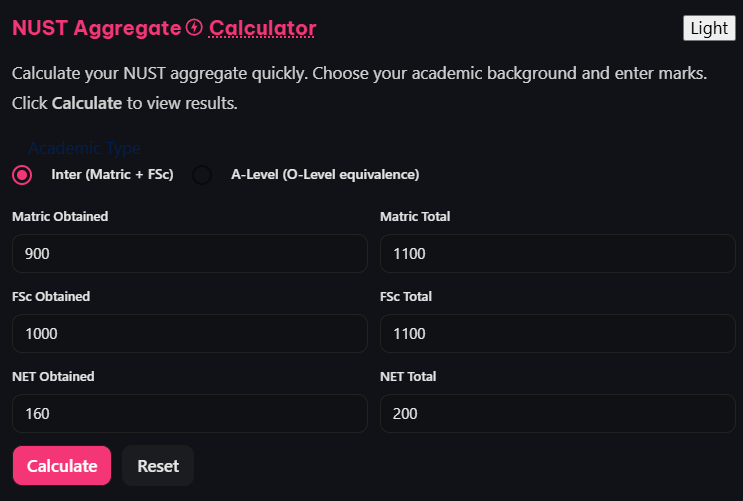
Our calculator is designed to be simple and intuitive. Follow these steps to get your aggregate in seconds:
- Select Your Academic Background: Choose whether you are an Inter (FSc) student or an A-Level student. The formula changes depending on your qualification.
- Enter Your Academic Scores:
- For Inter students, input your obtained and total marks for both Matric and FSc (Part 1 if Part 2 results are not yet available).
- For A-Level students, enter your O-Level equivalence percentage as issued by the Inter Board Committee of Chairmen (IBCC).
- Enter Your NET Score: Input your obtained and total marks from the NUST Entry Test (NET). The total marks are 200.
- Click “Calculate Your NUST Aggregate Now”: The tool will instantly compute your aggregate percentage and display it.
Now, let’s explore the formulas behind the calculation.
NUST Aggregate Formula for Inter Students
For students with a Matric and FSc background, NUST uses a weighted formula that combines scores from three areas.
| Component | Weightage |
| NET Score | 75% |
| FSc Marks | 15% |
| Matric Marks | 10% |
The formula is:
Aggregate % = ([NET Score / 200] * 75) + ([FSc Marks / Total FSc Marks] * 15) + ([Matric Marks / Total Matric Marks] * 10)
Example Calculation:
Let’s say an Inter student has the following scores:
- Matric Marks: 900 / 1100
- FSc Marks: 1000 / 1100
- NET Score: 150 / 200
Here is the step-by-step calculation:
- NET Contribution: (150 / 200) * 75 = 56.25%
- FSc Contribution: (1000 / 1100) * 15 = 13.64%
- Matric Contribution: (900 / 1100) * 10 = 8.18%
Total Aggregate: 56.25 + 13.64 + 8.18 = **78.07%**
NUST Aggregate Formula for A-Level Students
For students with an O-Level and A-Level background who are in their final year, the formula is slightly different. The weightage is split between the NET score and O-Level equivalence.
| Component | Weightage |
| NET Score | 75% |
| O-Level Equivalence | 25% |
The formula is:
Aggregate % = ([NET Score / 200] * 75) + ([O-Level Equivalence % / 100] * 25)
Example Calculation:
Consider an A-Level student with these scores:
- O-Level Equivalence: 80% (as per IBCC certificate)
- NET Score: 160 / 200
Here is the step-by-step calculation:
- NET Contribution: (160 / 200) * 75 = 60.00%
- O-Level Contribution: (80 / 100) * 25 = 20.00%
Total Aggregate: 60.00 + 20.00 = **80.00%**
Improve Your Aggregate: Tips for the NET
Since the NET score accounts for 75% of your aggregate, it’s the most critical part of your application. Here are some tips to help you score well:
Understand the Test Pattern
Familiarize yourself with the NET pattern for your specific program. The distribution of questions varies across disciplines.
Focus on Core Concepts
Don’t just memorize formulas. Build a strong understanding of the fundamental concepts in Mathematics, Physics, Chemistry, and English.
Practice with Past Papers
Solving past NET papers is the best way to understand the question style, difficulty level, and time constraints.
Master Time Management
The NET is a timed test. Practice solving MCQs quickly and accurately to ensure you can attempt the entire paper.
Strengthen Weak Areas
Use mock tests to identify subjects or topics where you struggle. Dedicate extra study time to these areas.
Prepare for the Intelligence Section
This section tests logical reasoning and analytical skills. Practice with brain teasers and puzzles to sharpen your abilities.
Get Enough Rest
Ensure you are well-rested before the exam. A tired mind is more likely to make careless mistakes.
NET Test Patterns
The NET structure varies depending on the program you are applying for. Knowing the specific pattern for your field is essential for targeted preparation.
| Program | NET Series | Test Breakdown (200 MCQs) |
| Engineering / Computing | NET-Engineering | Mathematics (80), Physics (60), Chemistry (30), English (20), Intelligence (10) |
| Biotechnology / Environmental Science | NET-Applied Sciences | Biology (80), Chemistry (60), Physics (30), English (20), Intelligence (10) |
| Architecture / Industrial Design | NET-Architecture | Mathematics (80), Physics (60), Chemistry/Computer (30), English (20), Intelligence (10) |
| Business Studies / Social Sciences | NET-Business & Social Sci. | Varies by program, typically focuses on English, Quantitative, and Verbal reasoning. |
Other Factors NUST Considers
While your aggregate score is the primary factor for admission, NUST also considers other criteria:
- Eligibility: You must have at least 60% marks in your SSC and HSSC (or their equivalents).
- Program-Specific Requirements: Some programs have specific subject prerequisites. For example, engineering programs require a background in Pre-Engineering or equivalent.
- SAT/ACT Scores: NUST accepts SAT or ACT scores for admission to certain programs and for international seats. The weightage formula for these admissions is different, so be sure to check the official NUST website for details.
Your Path to NUST Starts Here
Securing admission to NUST is a challenging but achievable goal. By understanding the aggregate calculation and focusing your efforts on the NET, you can significantly improve your chances of success.
Use our NUST aggregate calculator to find out where you stand, identify your targets, and start your preparation with a clear and confident mindset.