Semester 1
| Course | Credit Hours | Grade |
|---|
Understanding how to calculate your CGPA at the University of Management and Technology (UMT) is essential for tracking your academic progress and planning your future goals.
Whether you’re applying for scholarships, preparing for graduate school, or simply monitoring your performance, knowing your exact CGPA helps you make informed decisions about your education.
Understanding the UMT Grading System
Before diving into calculations, you need to understand how UMT evaluates student performance.
The university uses a letter grade system with corresponding grade points that align with international standards.
Here’s the complete UMT grading scheme:
| Letter Grade | Grade Points | Marks Range |
| A | 4.00 | 85.00 – 100.00 |
| A- | 3.70 | 80.00 – 84.99 |
| B+ | 3.30 | 75.00 – 79.99 |
| B | 3.00 | 70.00 – 74.99 |
| B- | 2.70 | 65.00 – 69.99 |
| C+ | 2.30 | 61.00 – 64.99 |
| C | 2.00 | 58.00 – 60.99 |
| C- | 1.70 | 55.00 – 57.99 |
| D | 1.00 | 50.00 – 54.99 |
| F | 0.00 | 0.00 – 49.99 |
Step-by-Step Guide to Calculate SGPA
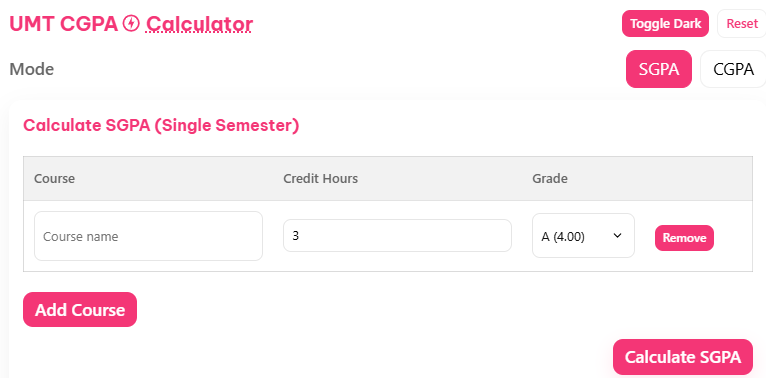
SGPA (Semester Grade Point Average) represents your performance in a single semester. Here’s how to calculate it:
Formula for SGPA
SGPA = Total Grade Points Earned in a Semester ÷ Total Credit Hours in that Semester
Steps to Calculate SGPA:
- List all your courses for the semester
- Note the credit hours for each course
- Identify the grade you received in each course
- Find the corresponding grade points using the UMT grading table
- Multiply credit hours by grade points for each course
- Sum up all the results from step 5
- Divide by total credit hours for the semester
SGPA Calculation Example:
Let’s say you completed these courses in one semester:
| Course | Credit Hours | Grade | Grade Points | Credit × Grade Points |
| Math | 3 | B+ | 3.30 | 3 × 3.30 = 9.90 |
| Physics | 4 | A | 4.00 | 4 × 4.00 = 16.00 |
| English | 3 | B | 3.00 | 3 × 3.00 = 9.00 |
| Lab | 2 | A- | 3.70 | 2 × 3.70 = 7.40 |
Total Credit Hours: 3 + 4 + 3 + 2 = 12
Total Grade Points: 9.90 + 16.00 + 9.00 + 7.40 = 42.30
SGPA: 42.30 ÷ 12 = 3.53
Step-by-Step Guide to Calculate CGPA
CGPA (Cumulative Grade Point Average) shows your overall academic performance across all completed semesters.
Formula for CGPA
CGPA = Total Grade Points from All Semesters ÷ Total Credit Hours from All Semesters
Steps to Calculate CGPA:
- Calculate SGPA for each completed semester
- Note total credit hours for each semester
- Calculate total grade points for each semester (SGPA × Credit Hours)
- Add up all grade points from all semesters
- Add up all credit hours from all semesters
- Divide total grade points by total credit hours
Detailed CGPA Calculation Examples
Example 1: Simple Two-Semester Calculation
A student completed two semesters with the following results:
Semester 1:
- Total Credit Hours: 15
- Total Grade Points: 45
- SGPA: 45 ÷ 15 = 3.0
Semester 2:
- Total Credit Hours: 16
- Total Grade Points: 48
- SGPA: 48 ÷ 16 = 3.0
CGPA Calculation:
- Total Credit Hours: 15 + 16 = 31
- Total Grade Points: 45 + 48 = 93
- CGPA: 93 ÷ 31 = 3.0
Example 2: Comprehensive Multi-Course Calculation
Here’s a more detailed example showing individual course calculations:
Semester 1 Courses:
| Course | Credit Hours | Grade | Grade Points | Total Points |
| Course A | 3 | B+ | 3.30 | 9.90 |
| Course B | 3 | A | 4.00 | 12.00 |
| Course C | 3 | B | 3.00 | 9.00 |
| Course D | 3 | C+ | 2.30 | 6.90 |
| Course E | 3 | A- | 3.70 | 11.10 |
Semester 1 totals: 15 credit hours, 48.90 grade points
Semester 2 Courses:
| Course | Credit Hours | Grade | Grade Points | Total Points |
| Course F | 4 | A | 4.00 | 16.00 |
| Course G | 4 | B+ | 3.30 | 13.20 |
| Course H | 3 | B | 3.00 | 9.00 |
| Course I | 3 | C+ | 2.30 | 6.90 |
| Course J | 2 | B- | 2.70 | 5.40 |
Semester 2 totals: 16 credit hours, 50.50 grade points
Final CGPA Calculation:
- Total Credit Hours: 15 + 16 = 31
- Total Grade Points: 48.90 + 50.50 = 99.40
- CGPA: 99.40 ÷ 31 = 3.21
Essential Tips to Maintain a Good CGPA
Maintaining a strong CGPA requires consistent effort and smart strategies:
Academic Strategies:
- Attend all classes regularly – Missing lectures makes it harder to understand complex topics
- Submit assignments on time – Late submissions often result in grade penalties
- Participate actively in class – Engagement often contributes to your overall grade
- Form study groups – Collaborative learning helps clarify difficult concepts
Time Management Tips:
- Create a study schedule and stick to it consistently
- Start assignments early to avoid last-minute stress
- Use campus resources like tutoring centers and office hours
- Balance coursework across all subjects rather than focusing on just one
Grade Improvement Techniques:
- Focus on high-credit courses – Better grades in courses with more credit hours have greater impact
- Seek help early – Don’t wait until you’re struggling to ask for assistance
- Review past exams – Understanding your mistakes helps prevent repetition
- Stay organized – Keep track of all assignments, deadlines, and exam dates
Frequently Asked Questions
What’s considered a good CGPA at UMT?
A CGPA of 3.0 or above is generally considered good, while 3.5+ is excellent and opens doors to scholarships and honors programs.
Can I improve my CGPA after a poor semester?
Yes, but it becomes progressively harder as you complete more semesters. Focus on achieving the highest possible grades in remaining courses.
How does UMT handle repeated courses?
UMT typically uses the higher grade when a course is repeated, but policies may vary. Check with the academic office for specific rules.
What CGPA do I need for graduation?
Most UMT programs require a minimum CGPA of 2.0 for graduation, though some programs may have higher requirements.
Take Control of Your Academic Future
Ready to calculate your CGPA quickly and accurately? Use our free calculator today and take the first step toward academic excellence at UMT.