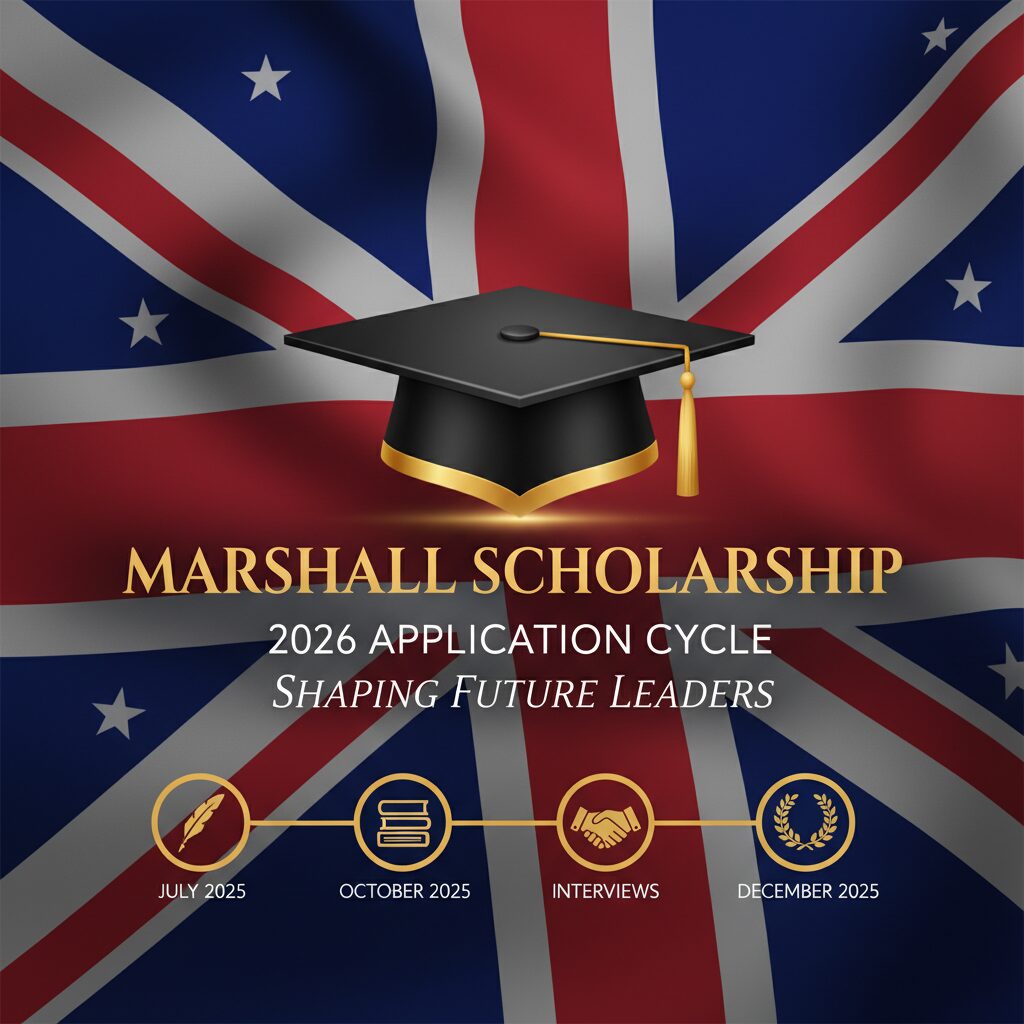
For intellectually distinguished young Americans, few opportunities rival the prestige of the Marshall Scholarship.
Created by the British Parliament in 1953 as a living gift to the United States, this scholarship finances graduate study at any university in the United Kingdom.
Scholarship Summary: What is Marshall?
The Marshall Scholarship is not merely a funding source; it is a diplomatic investment.
The program selects American students who have the potential to excel as scholars, leaders, and ambassadors.
Unlike the Rhodes Scholarship (which is specific to Oxford) or the Gates Cambridge (specific to Cambridge), the Marshall allows you to study at any university in the UK.
Scholarship Coverage and Benefits
The award is comprehensive, generally valued at around £38,000–£45,000 per year depending on your university location.
- University Fees: Full tuition payment for your approved degree(s).
- Living Stipend: A monthly maintenance allowance to cover housing and food.
- Travel: Airfare to and from the United States, plus unlimited travel within the UK for scholarship-related activities.
- Grants: Allowances for books, thesis research, and study travel.
- Spousal Support: A contribution toward the support of a dependent spouse (where applicable).
Eligibility and Selection Criteria
Before you begin drafting essays, you must ensure you meet the strict eligibility requirements. The selection committee is rigorous, there are no exceptions to these rules.
| Criteria | Requirement Details |
| Citizenship | You must be a U.S. citizen at the time of application. |
| Education | You must hold a first undergraduate degree from an accredited 4-year US college/university by September 2026. |
| Graduation Date | You must have graduated from your first undergraduate degree after April 2023. |
| GPA | Minimum GPA of 3.7 (unrounded) on your undergraduate degree. |
| Exclusions | You are not eligible if you have already studied for or hold a degree/qualification from a British university (including GCSEs or A-levels). |
The Three Pillars of Selection
The selection committees evaluate candidates on three equally weighted criteria. Understanding these is the key to a successful application.
Academic Merit
You must be intellectually distinguished. This goes beyond grades; selectors look for rigorous coursework, research contributions, and a specific, well-researched academic program in the UK.
Leadership Potential
You must demonstrate an ability to deliver results. This isn’t just holding a title (like “Club President”). It is about initiating change, mobilizing others, and showing strength of purpose.
Ambassadorial Potential
This is where most applicants fail. You must show that you understand US-UK relations and are eager to engage with British society.
You are expected to be a cultural bridge, not just a student in a library.
2025-2026 Application Timeline
The application process for the 2026 scholarship (tenure beginning Fall 2026) operates on a strict schedule.
Note: If you are currently a student, your university will have an internal “Campus Deadline” that is much earlier than the national deadline.
| Phase | Timeframe | Action Item |
| Application Opens | Early June 2025 | The online application portal opens. Start drafting essays immediately. |
| Campus Deadlines | August 1 – September 1, 2025 | Most universities require you to submit materials internally for endorsement. Check with your fellowship office! |
| National Deadline | September 16, 2025 | Strict Deadline. Full application must be submitted by 5:00 PM in the time zone of your endorsing institution. |
| Endorsement Deadline | September 18, 2025 | Your university must submit their official endorsement letter by this date. |
| Interview Invites | Early November 2025 | Shortlisted candidates are invited for interviews at regional centers. |
| Final Interviews | Mid-November 2025 | Interviews take place (usually virtually or in regional hubs like DC, Boston, SF). |
| Selection | Early December 2025 | The Class of 2026 Marshall Scholars is announced. |
How to Apply: A Step-by-Step Guide
Step 1: Secure Institutional Endorsement
You cannot apply directly to the Marshall Commission without an endorsement from your undergraduate institution.
Action
Contact your university’s “Office of National Fellowships” or “Undergraduate Research” office immediately.
Why
They will likely require you to submit an application to them first (usually in August). They will interview you and decide whether to endorse your application.
Step 2: Choose Your UK University
You need to propose a specific academic plan. You can choose a One-Year or Two-Year Marshall Scholarship.
One-Year
Ideal for rigorous 12-month master’s degrees.
Two-Year
The most common route. You can do one 2-year Master’s, two separate 1-year Master’s (at the same or different universities), or the first two years of a Doctorate (PhD/DPhil).
Tip: Do not just choose Oxford or Cambridge.
The Commission loves to see applicants utilizing institutions across the UK (e.g., Edinburgh, Manchester, King’s College London, Bristol) if those schools have the best specific program for your field.
Step 3: Write the Essays
The application requires several short essays. Avoid generic buzzwords; be specific about your “Why UK” and “Why Marshall.”
Personal Statement (750 words)
Your intellectual history and future vision.
Leadership Essay (500 words)
A concrete example of your leadership in action.
Ambassadorial Potential Essay (500 words)
How you will engage with the UK community and strengthen transatlantic ties.
Academic Proposal (500 words)
Why this specific UK university? Why is it better than a US program?
Step 4: Letters of Recommendation
You need three letters of recommendation.
- At least two must be from academics who have taught or supervised you.
- One should primarily address your leadership potential (this can be from a non-academic source).
- At least two recommenders must be based in the United States.
Frequently Asked Questions
Can I apply for both the Rhodes and the Marshall?
Yes, many students do. However, the applications are different. The Rhodes focuses heavily on “fighting the world’s fight” and is Oxford-specific.
The Marshall focuses on US-UK diplomatic relations and allows study anywhere in the UK.
What if my GPA is 3.69?
You are ineligible. The Marshall Commission is extremely strict regarding the 3.7 unrounded GPA cutoff.
Do I need to be accepted to a UK university before applying?
No. You apply for the scholarship first. If selected as a Scholar, the Commission will help facilitate your placement at the university, though you must eventually meet that university’s entry requirements.
Is the Marshall Scholarship available for Medical School?
Generally, no. The Marshall does not fund professional degrees like MDs or JDs in the way US schools structure them. However, you can study medical sciences or public health.
Next Steps
The Marshall Scholarship is a life-changing opportunity to join a network that includes Supreme Court justices, Pulitzer Prize winners, and scientific pioneers.
Start your preparation early, and good luck with the 2026 cycle!
